
The Room After the Room
Why connection often happens after the difficult thing is over

New to Open Enough Design? Read Start Here to discover how your room can make accidental connection the default.
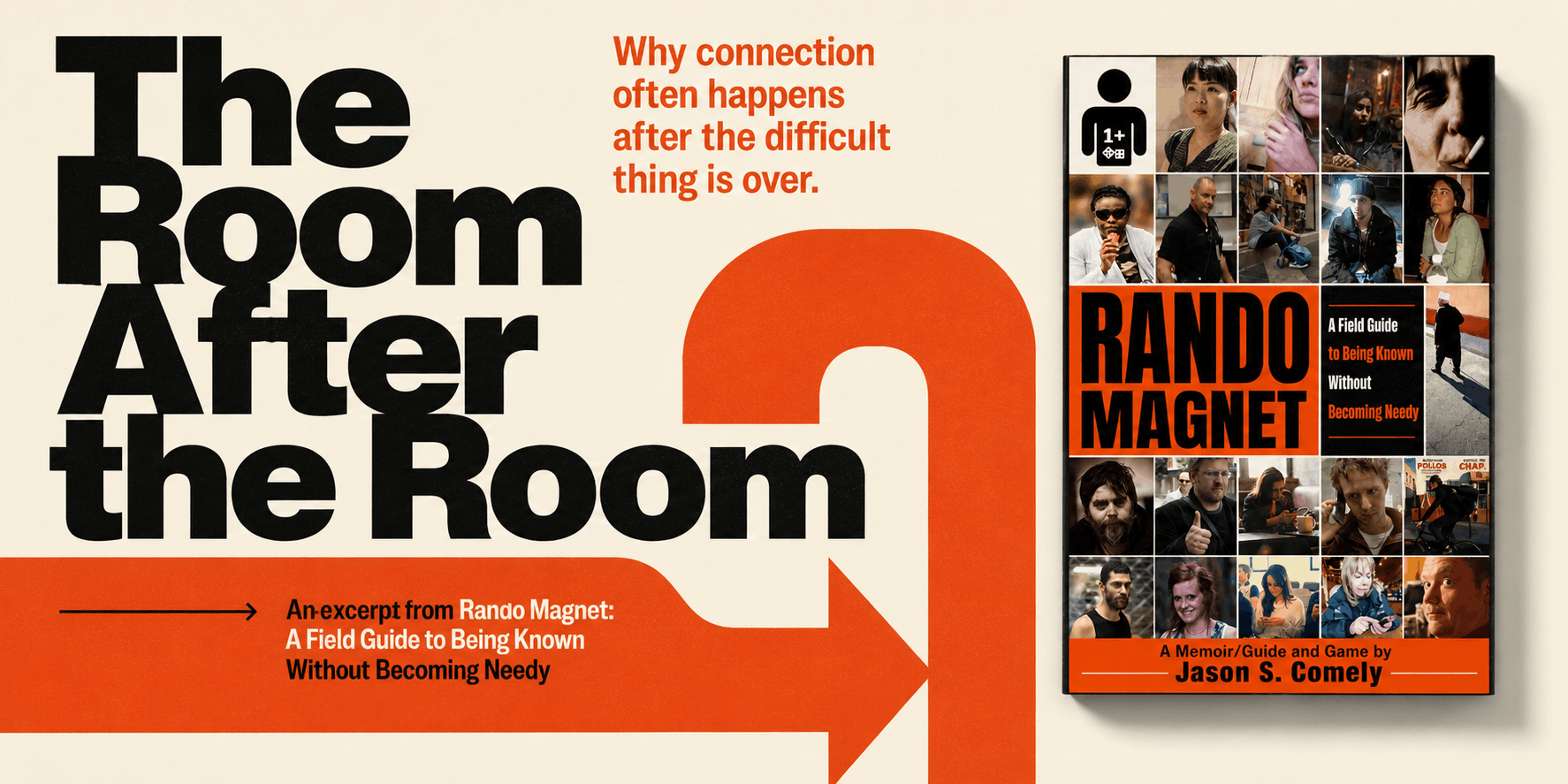
I’ve been using Open Enough Design methodology in a new way: not to redesign rooms, but to choose where I place myself inside them. The result is book, Rando Magnet: A Field Guide to Being Known Without Becoming Needy. It’s available now as a PDF and audiobook combo and a paperback.
The following excerpt describes one of the most useful discoveries from the experiment. Sometimes the room where people connect is not the room where the important thing happens. It is the room immediately after it.
Read on to find out what I mean.
I went to give blood. My brother was in the hospital and needed a lot of it, so my brothers and I decided to give some back. It was also, I’ll admit, a room I wanted to test.
They put me in a recliner in a room full of other donors. Bob Marley on the speakers, a screen looping pictures of beaches, the staff smiling and easy. Everyone reclined, relaxed, pleasant. Nobody said a word to anyone. It was a calm, friendly, completely dead room. People giving blood are turned inward, braced against the needle and sometimes the small dread of it, watching their own arm. A roomful of bodies, every one of them somewhere else.
Then they walked me to the next room over, and the next room was a different planet. A table, some chairs, snacks. The clinic makes you sit there ten minutes so they can be sure you won’t faint. A small enforced wait, except now the needle is behind you. The stress is spent. You are sitting at a shared table with food in front of you, on the far side of the thing you were all dreading, at the same time. And people open up.
I was working on a bag of chips when a guy sat down across from me, opened his own bag, and announced to me and the room that it was mostly air. I took the line and ran with it. A little talk about shrinking bags and shrinkflation, then a few questions to keep it going. How many times had he given. Sixty. Why he started. His father had always needed blood. I told him about my brother. He leaned into that, and when it felt right I gave him my name and got his. Ken.
Right then a woman came in and made the same kind of open comment about donating. I wanted to answer her, to find out her name too. But she saw that Ken and I were already deep in it, and she folded. She sat against the wall and didn’t look up from her phone again the whole ten minutes. She’d thrown a small hook into the room, felt it land flat, and reeled it back in. I missed her. You can only hold so many threads at once, and I had my hands full with Ken.
Here is what that pair of rooms taught me, and it is the most useful thing in this whole book. The blood clinic had two rooms running the same people through the same hour. The first was dead and the second was alive, and the only difference between them was the after. A decompression zone. The first room was all stress and inward focus. The second was the same crowd with the stress lifted off, held together a few extra minutes with something to eat. The name didn’t happen at the needle. It happened after the needle. It always does.
The sequence matters. The needle was over, so the body could settle. The ten-minute rule held us without trapping us because the exit was near and understood. The chips and communal table gave us something ordinary to share. Regulation, optionality, shared attention. The second room assembled all three.
A while later I went to a busy social-services office to see the opposite case. Big front room, a desk in the middle, cubicles in the back, a line at the counter that never got shorter because it kept refilling with people coming through the door. Tables and chairs everywhere, plenty of waiting, plenty of bodies. It was as cold a room as I have ever sat in. I watched it for half an hour and not one stranger spoke to another.
It took me a while to see why, and then it was obvious. The room had no place to decompress. You wait, you get called, you sit with a counsellor, and then you walk straight out the door onto the sidewalk. The relief, when it comes, comes alone, outside, with no one to turn to. And because the line at the front never empties, the quiet desperation in the room never breaks either. There is always a fresh face who hasn’t been seen yet, holding the whole place at the same pitch of waiting. A full room with no after will stay cold all day, no matter how many people pass through it.
So if you are ever in a position to build a room where you want strangers to meet, build the after. The shared ordeal gets them to the far side together. The snacks and the ten minutes hold them there a beat too long to leave as strangers. Skip that part and you can run a thousand people through the place and watch every one of them walk back out alone.
The design question: What difficult, structured, or stressful experience does your space provide… and where do people go immediately afterward?
A small table, an easy exit, something to eat, and ten unclaimed minutes may do more for human connection than the entire formal program.
This essay is adapted from Rando Magnet: A Field Guide to Being Known Without Becoming Needy, forthcoming from Kyyt Press.