
Your Bedside Table Isn't an Altar. It's a Survival Kit.
The spaces you didn't design that designed you anyway: Part 1

New to Open Enough Design? Read Start Here to discover how your room can make accidental connection the default.
A note went viral last week. A photo of a bedside table: lamp under glass, coffee in a pink cup, books stacked just so. The caption was four words: “your bedside table is an altar.”
Over 13K people agreed.
I left a comment: “The bedside table is the one surface you can’t curate for an audience, so it tells the truth. That’s why I wouldn’t call it an altar.”
Here’s what I meant.
An altar is intentional. You build it. You curate it. You arrange objects with purpose. Whether sacred or aesthetic, an altar is composed.
Your bedside table isn’t performing for anyone.
In Leave the Door Open, I write about the Reach Rule. It applies to people with limited mobility: can you reach water, light, phone, and emergency button without strain? That’s not convenience. That’s agency. The ability to meet your own needs without calling for help.
But here’s what I didn’t say in the book: when you’re horizontal in bed, everyone has limited mobility. You’re not getting up for water at 3am if you can bargain with your thirst. You’re not crossing the room for your glasses. The Reach Rule isn’t just for the wheelchair-bound. It’s universal. It kicks in every night when you lie down.
The bedside table is what your nervous system needs within arm’s reach when you’re least defended.
This is why the same objects keep appearing. I’ve been looking at photos of bedside tables all week, dozens of them, and the survival kit is always there. Water. A light source. Medication. Something to contact help. Something for comfort.
A woman named Mary has a CPAP machine, a bottle of Coffee-mate, and a small kettle on her nightstand. She’s built a complete life support system so she doesn’t have to face the household before her body is ready. A landline phone sits on another table next to pill bottles and a clock radio. That phone isn’t for scrolling. It’s for emergencies. For reaching someone if something goes wrong in the night.
One table has Willow Tree figurines, those faceless angel statues. “Mother and child.” Positioned to be the last thing seen before sleep. Another has a Hello Kitty plush that a grown woman is probably too embarrassed to mention but can’t quite throw away.
This is Regulation without performance. The nervous system’s actual requirements, visible only to you.
I do live assessments over Zoom: $30 for 15 minutes. No renovation. No redecorating. Just a trained eye on a room and a few suggestions to make it better for your nervous system and the people around you.
Email help@openenough.com to book a session.
But that’s not all the bedside table holds.
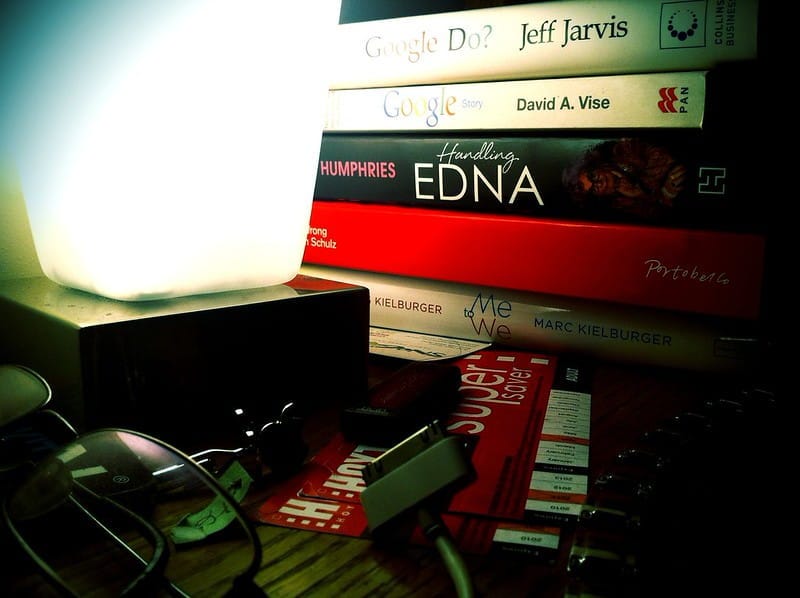
There are the books. Almost every table has them. The novel everyone’s talking about, abandoned on page 40. A self-help title that promised transformation. A CSS tutorial under a thriller under a biography. The Polish textbook I swore I’d study this week.
The book on your bedside table is hope. It’s the belief that tonight will be different. That you’ll read a chapter instead of scrolling. That you’ll become the person who reads before bed. And then you fall asleep after three pages, and the book stays there, waiting for the person you meant to be.
One photo showed a table that had become geological. Playing cards, dice, newspapers, trays stacked and overflowing. Layers of life deposited over time. No one is curating this. Things land and stay.
The viral photo showed only the survival kit, arranged beautifully. Real bedside tables show both: the kit and the accumulation. What you need and what you meant to become, tangled together on eighteen inches of wood.
The form varies by culture. A Japanese person with a small tray beside their futon and an American with a cluttered nightstand are solving the same problem. The question is universal: what does my nervous system need access to when I cannot get up?
So look at yours.
The CPAP machine isn’t clutter. It’s survival equipment. The water glass isn’t forgettable. It’s the most non-negotiable need you have. The comfort object, whatever it is, isn’t childish. It’s what your nervous system reaches for when every defense is down.
And the rest? The books you haven’t read, the projects you haven’t started, the evidence of who you meant to be? That’s shrapnel from the explosion of a life. It lands where it lands. It stays where it falls.
The bedside table is the last place you perform and the first place you stop. By the time you’re in bed, you’ve removed the watch, set down the keys, taken off the face you wear for the world. What remains on that surface is what remains of you.
Not what you worship. What you actually need when no one’s watching.
You didn’t design this space. It designed you.
What’s on yours?